
York County City Directory Collections
York County city directories survive as separate titles and runs, not as one complete countywide roll. The FamilySearch catalog documents early York, Delta, Hanover, Wrightsville, and York City volumes from several publishers. For an address question, the strongest confirmed reverse layer is the R. L. Polk York City Street Directory series. A City of York study reviewed that series from 1919 through 1997 at roughly five-year intervals. It identified 1919 as the earliest reviewed issue that paired street addresses with occupants. Rural addresses and communities outside the title’s stated coverage may need deeds, tax material, maps, or another local source.
| Directory collection | Years or issue | Where held | Access route |
|---|---|---|---|
| Boyd’s York directories | 1881–1882; 1883–1884; 1887–1888 | FamilySearch Library microfilm | Catalog film and DGS references |
| Young’s York City and County directory | 1886 | FamilySearch Library microfilm | Catalog item |
| Bell York City and County directory | 1894–1895 | FamilySearch Library microfilm | Catalog item |
| R. L. Polk York City volumes | 1898; 1899; 1902, 1903, 1905 | FamilySearch Library microfilm | Catalog item |
| R. L. Polk York City Street Directories | 1919–1997 documented series | York County History Center | Ask for the specific street volume |
The catalog notes that a 1906 Polk issue was not published after the 1905 volume. It also distinguishes city titles from city-and-county titles. Record the full title, issue year, and place named on the title page before treating a hit as evidence for a York County address.
Note: A cataloged York title establishes the volume’s identity and scope, but it does not make coverage continuous or countywide.
York County City Directory Shelf Access
The York County History Center Library & Archives is the local reading-room route for historical directory work. Its room at 121 N. Pershing Ave. is open Tuesday through Saturday from 10 a.m. to 4 p.m. The History Center asks visitors to contact staff and reserve a research space in advance, which also gives staff time to pull likely files. Holdings include York City and County directories, yearbooks, historical atlases and maps, local newspapers on microfilm, genealogies, and local history books. On-site databases include Ancestry Library Edition, Newspapers.com Pennsylvania Edition, and Fold3.
Start with the York County Libraries virtual library for the public-library and digital-research layer, then plan the reading-room visit for material that remains on site. The two systems complement one another: the county library system has broad public access, while the History Center is the specialized repository for rare local material and original research files.
York County Libraries’ virtual library points researchers toward its Local History Room, genealogy material, and YCHistory.org resources.
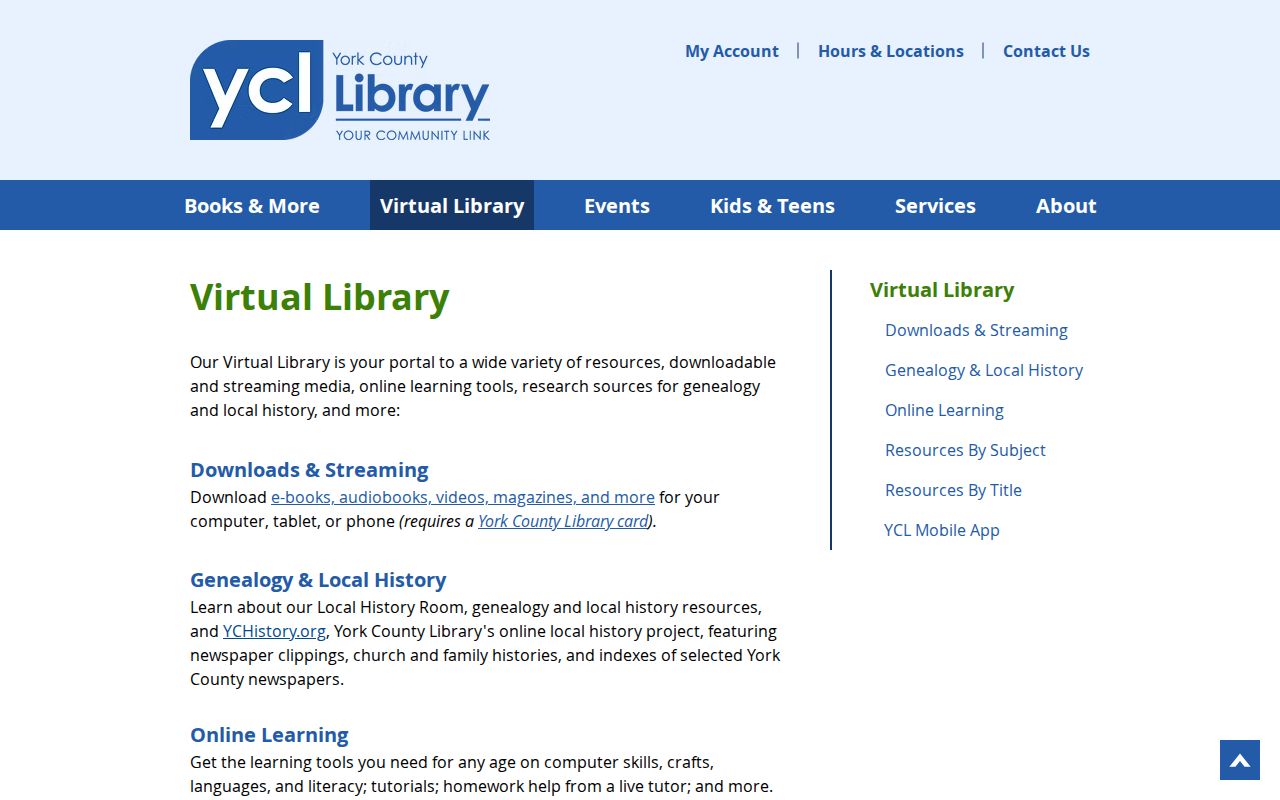
The library gateway is a useful first stop, but the directory volume, map, and surname-file details still need to be checked against the repository that holds them.
York County City Directories by Publisher
Publisher names explain what a given York volume can answer. Boyd’s volumes combine citizen names with a business directory for principal county towns. Young’s 1886 title is a city-and-county directory. Bell’s 1894–95 volume reaches York City, Delta, Hanover, and Wrightsville and adds an alphabetical county directory, classified business pages, officials, and a new street directory. Polk appears in city-and-county and York City titles before the documented street-directory run. Those labels are evidence of scope, not a promise that each edition indexed every household in every municipality.
- 1881–1882: Boyd’s York directory opens the verified FamilySearch compilation with a citizen and business layer.
- 1886: Young’s York City and County directory documents a city-and-county title from the Evening Dispatch office.
- 1894–1895: Bell’s volume adds York City and several county communities, plus a new street directory.
- 1898–1905: Polk York City and County or York City volumes appear in the catalog; the catalog notes no 1906 publication.
- 1919–1997: The City’s historic study documents the Polk York City Street Directory series used for address-to-occupant review.
FamilySearch catalog 728859 records the title, publisher, film item, and digital group reference for these early volumes. Its ten-reel compilation can document a missing or uncertain title even when an image has access limits. Check the cataloged title against the place in question rather than assuming “York” means every York County municipality.
The FamilySearch catalog for York directories preserves the publisher and reel-level trail for Boyd, Young, Bell, and Polk titles.
Catalog detail helps select a particular edition before a visit or a FamilySearch access request, rather than treating a directory title as a single continuous series.
Reading a York County City Directory Entry
The City’s digitized Appendix C gives a grounded way to read the York Polk street directories. It transcribes listings for 146 through 150 North Beaver Street in selected years. The observed fields are address or address range, a named occupant or business, and sometimes a use description or a rear-address qualifier. That is narrower than the broad family profile often expected from an alphabetical directory. Use the entry to establish that a name or business was documented at that address in that edition, then verify any broader conclusion with records that fit the question.
| 1919 | 150 North Beaver Street: Keystone Farm Machinery Co. |
|---|---|
| 1923 | 146–150: York Motor Express Co.; 150: York Reo Co. |
| 1929–30 | 150: N. B. Danner, garage; Samuel Lieberknecht Sons, autos |
| 1939–40 | 150 and 150 rear: North Beaver Street Garage; Adams Transit Co.; Warner-Freuhauf Trailer Co. |
| 1997 | 146: Charles A. Shandry; 150: B & C Fasteners, hardware |
- Street-directory entry
- An address-ordered listing that can connect a street number with a documented occupant, business, or use in one edition.
- Reverse or criss-cross finding
- A general term for address-to-name material. York’s confirmed source is the Polk Street Directory run, not a verified standalone volume with that title.
- Address range
- A span such as 146–150. It should not be read as proof that a named item occupied every number in the range.
- Rear qualifier
- A separate location behind or associated with the main street number, shown in the observed 1939–40 transcription as “150 rear.”
York County City Directory Entry Limits
A street-directory hit can be powerful, but it is dated and selective. The North Beaver examples include businesses, multiple names at one address, and a rear qualifier. They do not establish a full present or past household. The City report treated a blank address listing as generally unoccupied for that environmental analysis, yet that interpretation belongs to its particular project and should be applied cautiously to a household question. A directory may omit an unlisted person, a rural address, or a community outside its title’s coverage.
For a modern parcel and recorded-owner chain, use the address-focused York County streets resource rather than forcing a historic volume to answer a current question. The History Center also warns that directory and telephone hits identify a listing, not every household member, while deeds and tax records may identify ownership rather than occupancy.
Note: Preserve the edition year, exact title, street form, and page citation with every directory note so another record can test the same claim.
Tracing York County City Directory Households
Trace a household through the directories as a dated sequence. Begin with the exact title that covers the place and year. Keep surname variants together, record every address form, and compare an alphabetical name listing with a Polk street listing when the volume has one. Pair selected directory dates with the federal census, which is publicly available through 1950, or with York’s 1786, 1793, 1800, and 1807 septennial census microfilm when the era fits. A move, a changed business label, or a vanished listing becomes a lead to test, not a final answer.
- Select the directory title that names the City of York or the county town being researched.
- Record the person or business name, address, year, page, and any range or rear qualifier exactly as printed.
- Check the next available directory year, then use the street directory when an address needs an address-to-name check.
- Pair a directory date with the appropriate federal or York septennial census schedule for household context.
- Use a deed, map, obituary, cemetery card, probate record, or church register to test the change found between editions.
Directories do not announce why a name disappears. The person may have moved, died, been omitted, or fallen outside the volume’s geographic reach. The History Center’s newspaper, cemetery, surname-file, church, and estate holdings give a local route for testing those possibilities.
York County Street Alias Check
Street names can make a sound search look empty. The City’s Northwest Triangle study shows North Water Street in its 1887, 1894, and 1908 map evidence, then North Pershing Avenue from 1933 forward. Search both forms for a City of York address and check the map sheet before declaring an address or occupant missing. The same caution applies across York County, where a York mailing label can sit outside the City and municipal boundaries vary.
The City’s historic-site report also uses the Polk street directories alongside map evidence. Its comparison is useful because a directory provides a time-stamped listing, while a map helps determine whether the street name, lot, or structure was understood correctly. Neither source alone confirms a complete household.
York County Family Companion Files
When a directory name needs context, the History Center’s family collection can extend the trail. Its surname files number more than 9,000 and may include church, estate, tax, burial, obituary, and wedding or engagement-clipping material. The collection also has Family Reports compiled largely from local source types. These are research aids rather than official replacements, so keep the directory citation beside the later supporting record.
The History Center Surname Database is the on-site starting point for spelling variants. For early periods, the family guide identifies newspaper death and marriage indexes from 1783 to 1909, a Will Index from 1749 to 1940, and Orphans’ Court and will abstractions from 1749 to 1850. These collections can help distinguish people with the same name and close a family-history trail without overstating what a directory entry proves.
Note: Keep an archival family-file finding separate from a directory citation, then identify the record type and date that supports each conclusion.